

Introducing Your Monthly Money Cheat Code: Summer is for Road Trips and Auditing Your Auto Insurance
Don't fall asleep at the wheel! Follow these 3 steps to save money on your car insurance.


Whether you have a well paying job, are making ends meet while on the job hunt, or are living off your retirement savings, life is probably feeling pretty expensive these days. With inflation pushing higher and everything turning into a subscription service, it can feel like no matter what you do more money slips through your fingers each month. It’s a frustrating situation for sure, but you still have plenty of control over your finances.
That’s why I’m excited to announce that we’re launching a monthly financial audit series called Your Monthly Money Cheat Code. Each month Rochelle Coleman, founder of Second Stage Finance, will dive into a specific financial topic and help you identify opportunities where you can reduce your monthly expenses. Most of these will be small tweaks but making these changes can lead to major savings and increase your financial flexibility.
If you have specific financial questions on your mind, Rochelle will also be hosting a free Personal Finance Office Hour session each month, where you can meet with her to discuss the situation you’re navigating. You can learn more about what to expect during these sessions and RSVP using the button below.

Checking Under the Hood: The 15-Minute Auto Insurance Audit
I am a big proponent of finding easy wins to cut costs on unavoidable expenses, and car insurance is a prime example. There are big wins you can go after, like building up savings so you can comfortably opt for a higher deductible, or paying annually or bi-annually instead of monthly to eliminate processing fees.
But there are also hidden, smaller reductions hiding in plain sight. When I first started looking for ways to trim my own car insurance bill, I called my car insurance GEICO and asked a simple question: “What discounts am I missing out on?”
As we went through my profile, the agent started uncovering savings based on details I’d never thought to mention:
Safety Features: Having passenger airbags saved me $7.26.
Anti-Theft: An active car alarm knocked off another $2.51.
Bundling: Confirming I also had renters insurance with them triggered an $11.65 multi-policy discount.
Alumni Discount: Simply graduating from Syracuse University unlocked a “Sponsored Marketing” discount of $25.99.
They even gave me an 89 cent discount just for having functional seatbelts :)
By the end of the phone call, we had identified 8 different discounts I qualified for but wasn’t receiving. It took just a few minutes of my time and ended up saving me $342.02 a year.
It’s easy to set your auto insurance to Auto-Pay and forget about it, but this often means you miss out on potential savings every month. As your life evolves, perhaps you drive less, your car gets older, or your personal finances improve, your current policy might no longer be the best fit.
Your Turn
It’ll probably only take about 15 minutes for you to review your coverage and identify areas where you may be eligible for a discount or are paying for more protection than you need.
Step 1: Review Your Policy
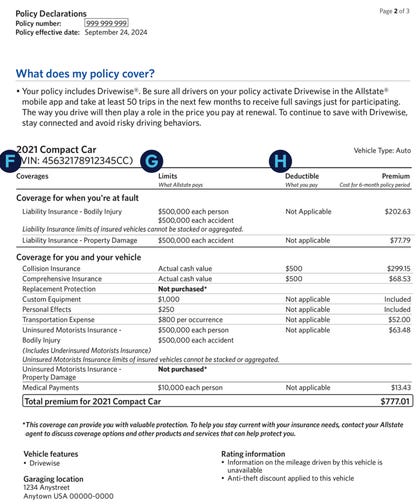
You’ll want to start by looking at your Policy Declarations Page. It’s a one page summary of the coverage you’re paying for. It has all the numbers you need. Here’s an infographic from Allstate that’ll help you understand what you’ll find on your Policy Declaration.
Step 2: Pause and Reflect
Here’s some reflection questions you can use during your initial review. Knowing these answers will help you prepare for later conversations with your insurance provider.
Am I a “Low-Mileage” driver?
If you commute less than 7,000 miles a year, you’re being charged for a risk you’re not taking.
Is my deductible stuck in the past?
If you have $1,000+ in emergency savings, is paying a higher premium for a tiny $250 deductible the right move?
Is my car overinsured?
If your car is 10+ years old, you may be paying Collision/Comprehensive coverage that costs more than the car’s actual replacement value.
Checking Kelly Blue Book can help you understand the current market value of your car and figure out if the premium you’re paying worth the potential payout.
Can I earn a “Paper” discount?
Many insurers give 5-10% off for defensive driving certificates or affiliations.
Step 3: Have the Conversation
Here’s some questions you can use when discussing possible discounts with your insurance provider.
For Low Mileage Drivers
I have reduced my annual mileage. Do you offer a low-mileage discount or a pay per mile tier that would lower my monthly premium?
Note: You can call and ask about available discounts. Or you can join programs like Geico’s Drive Easy or Progressive’s SnapShot. There are options for those who prefer to share their data (join a program) or not (call/chat).
When Rightsizing your Deductible
What is the price difference if I increase my deductible to $1,000? I’d like to see how much that lowers my annual premium.
Aligning Collision Coverage with Car Value
I’d like to see the price difference if I remove Collision and Comprehensive coverage on my [Year/Make/Model].
Finding “Paper” Discounts
Do you offer a discount for completing a defensive driving course? Also, can you check if my Alumni Association qualifies for an affinity discount.
Exploring Payment Schedules
Do you offer any discounts for paying my premium in one or two installments versus paying monthly?
Final Question
Is there a long time customer credit or policy discount I’m eligible for since I haven’t had a claim in X years? What discounts am I eligible for that are not currently being applied to my insurance?
When Exploring Other Providers
After doing this quick audit, you may decide that your current provider no longer fits your needs. If that’s the case for you, you want to make sure to use your exact current coverage (ex., 100/300/100 liability) when speaking with other providers.
Doing that will ensure you’re able to generate an accurate cost comparison and make the right choice.
Looking Ahead
I hope this article helped you realize the power you have over your auto insurance costs. Following the three steps outlined above could save you hundreds of dollars a year. Sounds pretty good for less than an hour’s worth of work, right?
Now I limited this list to a few key items to keep the audit under 15 minutes, but I understand that every bill is unique. If you see an unfamiliar fee or line item, please share it in the comments or bring it up during our next office hours session.
Stay tuned for our next Monthly Money Cheat Code where I’ll dive into everyone’s favorite topic: Utility Bills.
 | A guest post by
|
Very helpful! Thanks!