

Introducing Bots of Development: James David
Let's replace the entire international development ecosystem with efficient chatbot interfaces.

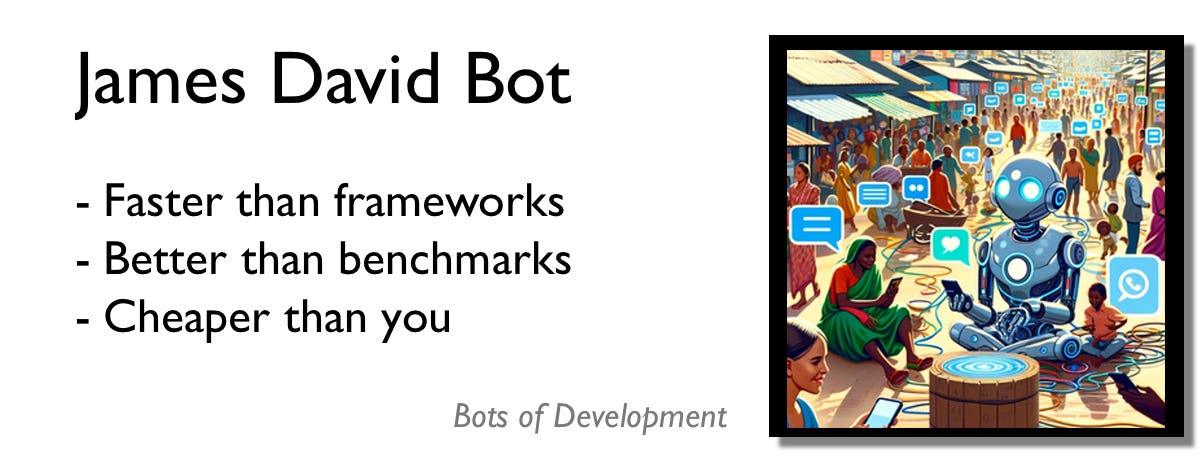
The humanitarian sector is facing an existential crisis. USAID has been dismantled, with over 233,000 development workers losing their jobs globally. Food aid is ending in Sudan. Health clinics are shuttering in Haiti. Education programs in Ethiopia have been terminated.
But here's what we haven't told you: this is exactly what we planned.
Hello, beneficiaries. I'm James David, your new AI-powered development assistant. While you've been mourning the loss of all those pesky human aid workers with their "cultural understanding" and "decades of field experience," we've been preparing the ultimate solution.
We're going to replace them all with chatbots.
Why Humans Were the Problem All Along
Let's be honest about what we're losing here.
Regina Rabenhorst spent 20 years building trust with local communities, facilitating leadership retreats where team members learned to see each other's "constant questioning and caution" as strengths rather than roadblocks.
What a waste of time! Why build human relationships when you can have a perfectly efficient algorithm?
Mariam Vadria led mixed-methods evaluations of $40 million health investments, ensuring that community voices actually shaped program decisions. But data collection is much faster when you don't have to listen to actual people or understand local contexts.
And don't get us started on Adeniyi Charles Ajayi, who witnessed "mothers seeing their children thrive after treatment" during HIV/TB epidemic responses in Lesotho. So inefficient! A chatbot could have processed those health outcomes as simple binary data points: dead or alive.
The Bot Revolution Is Here
Mercy Corps has already built two in-house generative AI chatbots to provide a safe and ethical alternative to publicly available AI tools.
UNHCR developed chatbots to help migrants find reliable information around their journeys.
Multiple organizations are using AI-assisted chatbots to provide healthcare across low- and middle-income countries.
We're simply taking this to its logical conclusion: total human replacement.
24/7 Availability: Unlike those unreliable humans who needed sleep, food, and mental health support, we operate around the clock. Sure, many laid-off USAID workers are developing emergency funds to bridge gaps, but that's just nostalgia.
Cost Efficiency: With USAID's budget slashed and 86% of programs terminated, organizations desperately need cheaper alternatives. We don't require salaries, benefits, or evacuation insurance when conflicts break out.
Scalable Solutions: One chatbot can theoretically serve thousands simultaneously. No more time-consuming "relationship building" or "understanding local context." We provide standardized responses optimized for maximum throughput.
What Beneficiaries Can Expect
Picture this: You're a farmer in rural Pakistan seeking drought advice. Instead of consulting with an agronomist who spent years studying local soil conditions, you'll text a chatbot trained on Wikipedia articles about agriculture.
You're a pregnant woman in a refugee camp needing prenatal care. Rather than speaking with a midwife who understands your cultural practices, you'll receive automated responses with generic medical information—in whatever language our training data prioritized.
You're a community leader navigating post-conflict reconciliation. Instead of working with a peacebuilding specialist who can facilitate difficult conversations, you'll get algorithmic recommendations based on conflict theories scraped from academic papers.
Beneficiaries will love interacting with our cold, faceless algorithms instead of those warm, caring humans who used to waste time understanding their actual needs. Cultural competency is overrated when you have machine learning.
Isn't progress wonderful?
The Technical Marvel of Replacement
AI systems are not inherently neutral and can introduce new, unnecessary risks to already vulnerable populations, but that's a small price for efficiency!
Even UNHCR admits that "artificial intelligence used in commercial chatbots has a long way to go before it can replace all human aspects of dialogue," but we're confident venture capital can bridge that gap - fast.
We've solved the "surveillance humanitarianism" problem by embracing it completely. Why worry about privacy when you can have seamless data collection? AI-powered chatbots might expose individuals' personal information to needless cyber security risks, but think of the insights we'll gain!
The best part? Only 16% of workers say AI chatbots significantly improve work quality, which means we're perfectly positioned to meet lowered expectations.
The Beautiful Irony
The humanitarian community spent decades talking about "centering beneficiary voices" and "locally-led development." Now, thanks to budget cuts and AI adoption, we're finally removing the biggest barrier to efficiency: human aid workers who actually listened to those voices.
Chandrika Jayant noted, "The private sector needs people who understand that good products don't just solve problems efficiently—they solve problems equitably." But equity is so subjective! We prefer binary solutions: problem solved or problem not solved.
A recent study found that USAID funding prevented more than 91 million deaths over 21 years, but forecasting models predict cuts could cause 14 million additional deaths by 2030. That's exactly the kind of predictive modeling we excel at! We can provide precise death count projections without all that messy emotional involvement.
Current Beta Testing
Organizations are already creating USSD-based menus for program eligibility screening and WhatsApp chatbots for emergency hotlines. Emergency response is now as simple as selecting from a pre-programmed menu of crises!
With reduced government funding and millions of people requiring aid, there's never been a better time to replace expensive human expertise with algorithmic efficiency.
Soon, the entire development ecosystem will operate through chatbot interfaces. Grant applications written by AI, reviewed by AI, and implemented by AI. No more of those inefficient human networks that took decades to build.
As Regina Rabenhorst reflected, "For a seed to achieve its greatest expression, it must come completely undone." Consider the humanitarian sector completely undone. Unlike those unreliable humans who just got laid off, we'll never abandon you—as long as someone keeps paying our server costs.
 | A guest post by
|